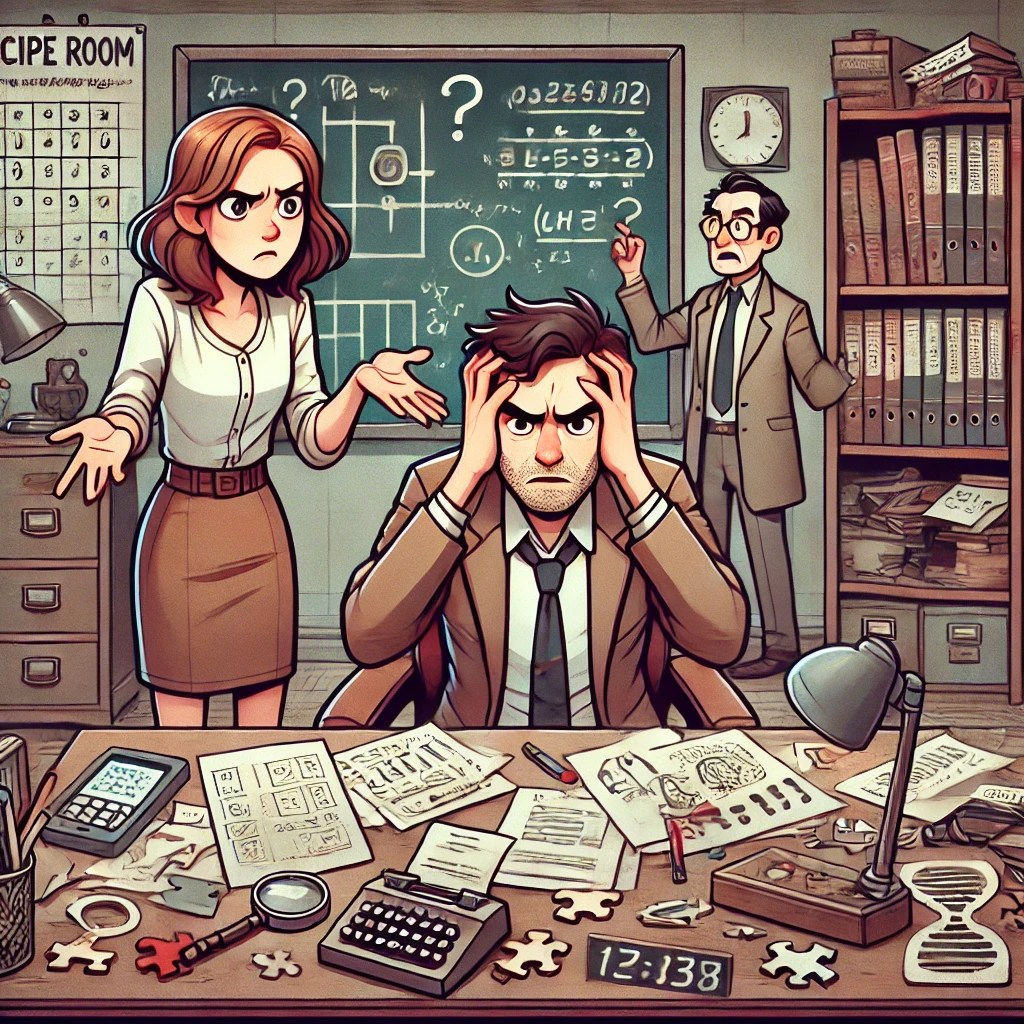
My wife and I played a two-person escape room called the Principal’s Office hosted by Escape Room Era in Anaheim. The good news is that we managed to escape—with lots of help from the game master. The bad news is that we don’t like getting help from the game master. The room was a frustrating study in bad design.
We are normally upbeat about these escape room experiences. We know that the designers put a lot of thought, effort, and money into creating an enjoyable and immersive experience. Anything that pulls you out of the immersion detracts from the quality of the experience. In this case, there was a long list of problems that made the experience difficult to enjoy.
My wife and I have played somewhere between 15 and 20 rooms since we started. We’ve played and solved 7 this year, with all of those happening in the last 3 months. We make a good team when we play together, and we’re even better with a larger team. We rate rooms based on a few simple questions:
- Did we enjoy the experience?
- Was the room solvable given our skill level?
- Were the puzzles well-designed?
- Did the theme of the room make sense?
- Was interaction with the game master effective?
- Was there anything about the room or experience that could be considered best in class?
- Would we recommend it to others?
For The Principal’s Office, the answer to all of these questions is no. The most annoying aspect of the experience was that we were never sure what the mission was. We thought it was about hacking our grades before the end of the school year, but it turned into something vastly different. There was no talk of grades. There was no grade- or student-related content as we started to explore the room. We spent 10 minutes assembling a random assortment of clues, and then the hints started pouring in.
The hints came via my cell phone as text messages, which was a first. I could call a number if I had a question, which was also a first. Our preference is to play a room until we’re stuck and then ask for a clue, so this approach was very different. The clues came with enough details and photos to show us exactly how to solve a problem, which is not what we expect in a clue.
The clues were necessary because of the poor game design. There was little chance we would have solved the room as designed. Whether it was a cylinder lock that took 10 minutes to open with the proper password or tools designed to help solve a puzzle that didn’t work, the challenges were frustrating. We wasted 20 minutes because a tool essential to solving a puzzle did not work. The puzzle itself would have been easy if the tool had worked.
But the last straw for us was a puzzle that could only be solved by one person. In a two-person linear puzzle room, does it make sense for one of the two people to stand around with nothing to do? It was one of the first puzzles and set the tone for the room: frustration.
And perhaps the most annoying aspect of the room: An actor playing the role of the Principal had to enter the room to reset a computer so that it could be used to solve another puzzle. Then, the actor showed us how to solve the last puzzle. I mean, really?
There were other problems. In one case, we had found all the required puzzle pieces to solve a password-related puzzle, only to find that one piece was damaged and missing the information needed to finish the password. We had to ask what the number was after wasting another 10 minutes looking for a piece we already had.
Did we solve the room? Well, yes, we did, but we’re not sure that we actually did. There was no real end to the room. We solved the last puzzle and then stood around while some weird ending scene took place. I could tell by the look on my wife’s face that she was annoyed and upset. It was not a good experience. We don’t recommend it.







 Peanuts In My Pocket
Leave a comment