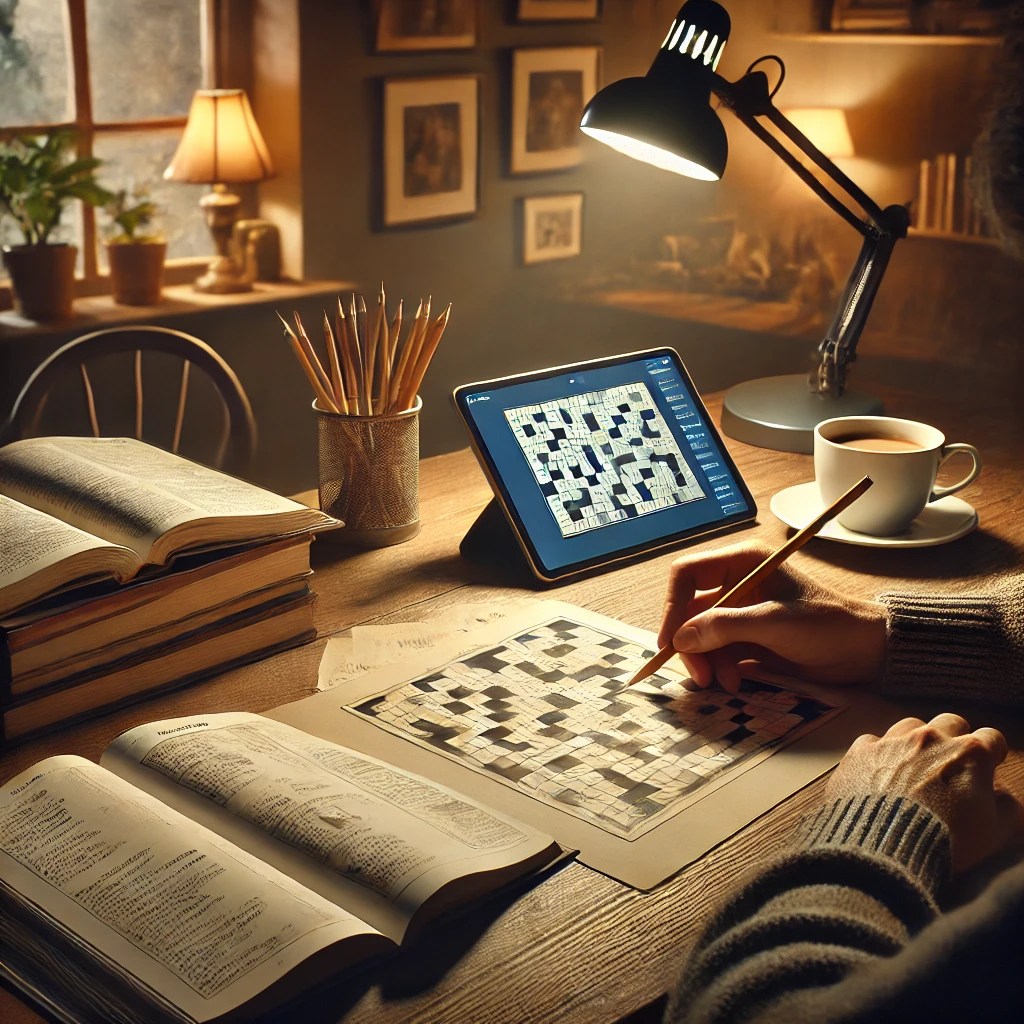
Crossword puzzles have always been a challenge for me. I find any puzzle involving spelling to be as frustrating as color theory is for a color-blind photographer. I overcame my color challenges by embracing black-and-white photography, but I’ve never really tried to improve at solving crosswords. I think that’s because I’ve always felt intimidated by a long-standing learning disability—I never truly mastered spelling. The only reason I spell better today than I did 20 years ago is because I’ve worked hard at it as part of my obsession with writing and journaling.
For example, in the previous paragraph, I misspelled ‘obsession.’ I left it until editing, then went back to understand the nature of my mistake. My first test is always: do I know how to spell this word? In this case, the answer was yes—I just left out some letters. It was an easy fix. But sometimes it’s a word I really can’t spell, so I do my best, use spell check, then jump to a dictionary to look it up. If it’s something I commonly misspell, I add it to my study list. Eventually, I’ll learn how to spell it correctly, but it takes effort. Some words, like decision, I almost never get right, no matter how hard I try.
I learned to spell at Hawaiian Elementary School in Lakewood, Calif. I was already behind my classmates when I arrived in 3rd grade, and it only got worse when I was introduced to phonics. Most of my problems have roots in irregular vowel sounds, but I’ve also realized that not understanding English spelling rules makes things worse. This is where my spelling issues overlap with crosswords—if you can’t spell and struggle with vowel sounds, crosswords are a nightmare.
Several people in my life have been avid crossword solvers, but the most memorable was my great-grandmother Ruth. She worked on a puzzle every day, and God help us if we interrupted her. One year, I gifted her the world’s largest crossword puzzle after discovering that I worked with the man who created it. When unfolded, the puzzle was the size of a king-sized bed. She worked on it for years.
I set a retirement goal to learn how to solve crossword puzzles. I started with the New York Times mini, with help from my puzzle-genius wife, Florence. For weeks now, I’ve worked through the daily mini until I hit my goal of solving it in under three minutes. I can do that about a third of the time now, so last week I moved up to the full puzzle. My first attempt—a Thursday puzzle—completely stumped me. Flo lovingly guided me through it. Last night, I attempted another one and, though I struggled, I completed it on my own while Flo watched.
I’ve given myself a few allowances to help with learning:
- I’m allowed to use a dictionary to check my spelling.
- I’m allowed to look up obscure references, especially pop culture ones I don’t know.
- I’m allowed to ask for help.
In the process, I’ve noticed the unofficial rules for deciphering clues, which I didn’t realize were so important. I’ve even built a reference I can consult when needed. I think of it as my crossword knowledge base, which includes noting the crossword author’s personal style—something I never thought about before.
I now understand why people like my wife enjoy crosswords. I was wrong in thinking they were just spelling tests for smart people. They’re more like complex logic puzzles that combine multiple skill sets. I’m in awe of anyone who can breeze through a puzzle. I’ll be happy when I can solve them without help.
I’m curious about how others approach crossword puzzles. If you have any tips or wisdom to share, please pass them along!


 Peanuts In My Pocket
Leave a comment