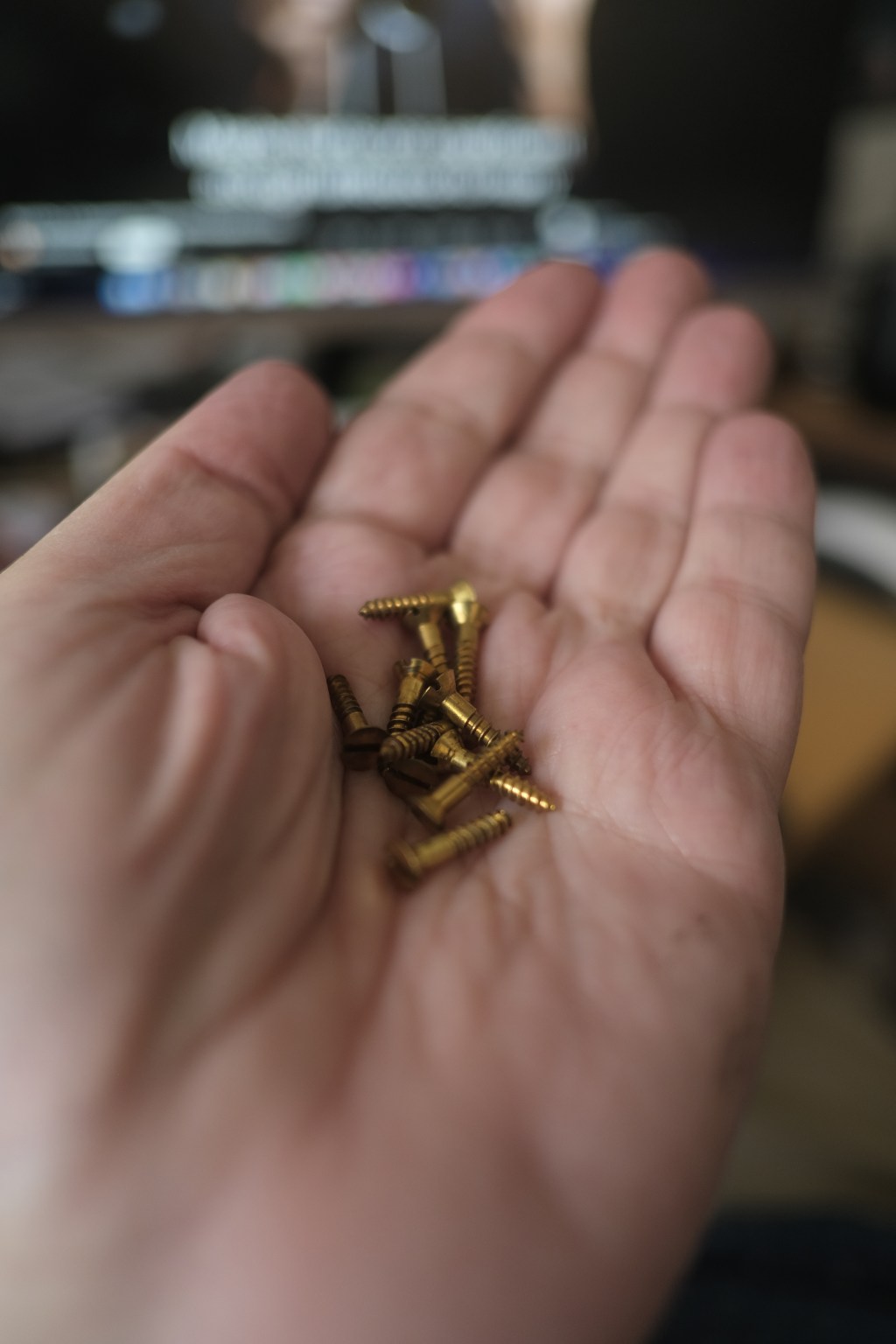
A few days ago, my grandson Dean was struggling with his cursive homework. My wife helped him but mentioned that learning cursive is hard, and that grandpa never learned how to do it. She explained that I had small motor skill problems that made it difficult for me to learn cursive. Dean, curious, came over to inspect my hands. I pretended my fingers were uncontrollable, and he believed the fib, asking questions about it whenever he had the chance. My wife and I laughed at the image we both had in mind—hot dog fingers, like from Everything Everywhere All at Once.
One of Dean’s questions was especially cute: “Grandpa, can you get robot hands? Would that help?” I explained that my hands work for most things, but small tasks like cursive writing or even printing were beyond me. I told him I compensate with other tools. His question made me reflect on how I’ve managed to get by without this key skill.
The condition is called fine motor skill difficulty. In children, it can be diagnosed as developmental coordination disorder (DCD), sometimes known as dyspraxia. For some, like me, the condition persists into adulthood. It’s been a challenge my whole life. An occupational therapist once told me that strengthening my grip could help improve coordination, and I’ve been somewhat obsessive about it at times.
I didn’t receive much support for the condition in school or at home. The approach at school was to “try harder,” while at home it was ridicule and teasing. The issue became a real problem when I entered the Air Force as an aircraft structural repair technician. Instead of fixing things, I often broke them, and my work was subpar compared to the craftsmen I worked with. There was no way to compensate for my lack of skill, so I became the guy who swept floors and mowed lawns instead.
After leaving the service, I started working an office job in a factory that built radar systems for fighter jets. My first boss, Marshal South, rejected all my handwritten work. Surrounded by engineers with perfect handwriting, there was no room for sloppiness. Marshal gave me a six-inch metal ruler and had me practice printing in block letters until my work met his standards. It took far longer than it should have for me to master this.
The second thing Marshal taught me was how to sign my name in cursive. I could do it, but it always looked like a child’s writing. Marshal suggested I make a mark instead of signing my name, which I still do today. My signature is unreadable but visually appealing. When my wife told Dean that the only thing I could write in cursive was my signature, I didn’t correct her.

I never could learn to draw or paint, either. To this day, my drawings look like something a third grader would produce. It’s not for lack of trying—I spent years attempting to improve, but I always fell short. I avoid games like Pictionary or anything that highlights this weakness. My lack of drawing skills eventually led me to photography. While I can’t produce the image in my head with my hands, I’ve learned I can do it with my eyes and a camera—as long as it’s in black and white, since I’m severely colorblind too.
Over the years, I’ve developed several coping mechanisms besides avoidance. Typing is one. While I’ll never be fast, I manage a steady 35 words per minute now. I’m grateful I learned to type in high school on an IBM Selectric, even though I got a D in the class.
Genetic predisposition: If one or both parents have motor skill difficulties, there is a higher likelihood (though not a guarantee) that their children could inherit similar tendencies. It’s more about increased risk than a direct inheritance of the condition.
It seems I may have passed this condition on to my boys. Our handwriting is identical, and it looks like something from grade school. Fortunately, they both have normal color vision. My friend David struggles with similar issues but has overcome many of his limitations as an adult—his artwork is incredible. I’ve been fortunate to have help along the way. I don’t consider this a problem anymore; it’s just something I’ve learned to live with. Just don’t ask me to fix or build anything for you—I’m good at knocking things down, but building things up is a disaster.






 Peanuts In My Pocket
Leave a comment