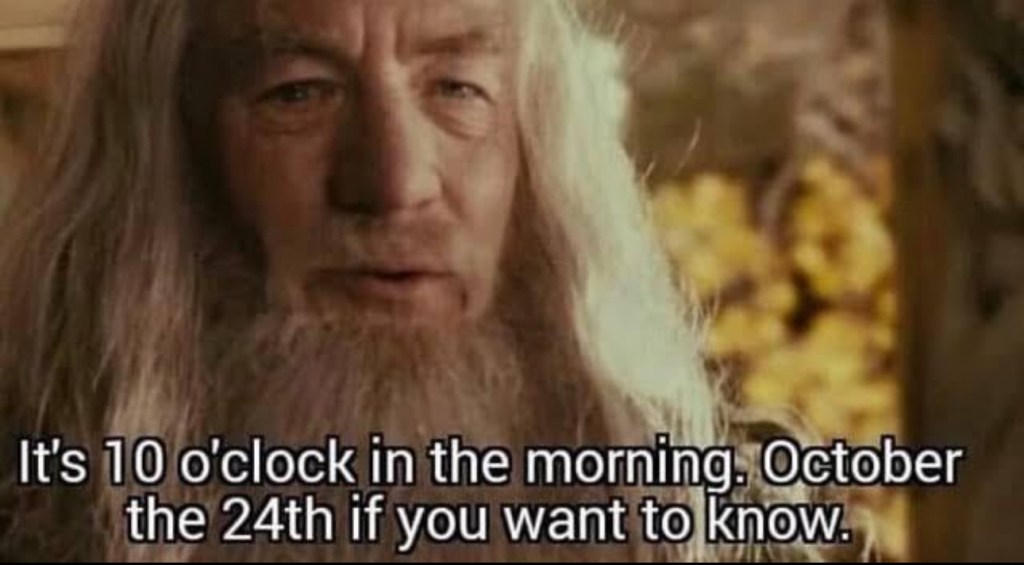
Yesterday was October 25th. At exactly 10:00 a.m., I sent a Lord of the Rings meme to a few friends, including my wife, Florence. She didn’t get it, which she immediately pointed out. I tried explaining, but her relentless logic soon dismantled the joke. You see, in The Fellowship of the Ring, Frodo wakes up in Rivendell on October 24th at precisely 10:00 a.m. Sharing a meme to commemorate that moment is both a nod to the story and kind of funny, considering the exact timing.
Florence, however, had a question: “Why would they use the Gregorian calendar in Lord of the Rings?” I fumbled for an answer, but what came out didn’t do me justice. As a self-proclaimed Tolkien lore master, I should know this stuff, but nothing coherent came to mind, and I offered a half-baked answer I’d rather not repeat.
That night, I couldn’t let it go. The question nagged at me. I woke up with it on my mind, suddenly remembering that the Shire actually had its own calendar system. I should’ve just looked it up last night and saved myself some sleep.
Of course, Florence was both right and wrong. The Gregorian calendar, introduced by Pope Gregory XIII in 1582 to reform the Julian calendar, has no place in Middle-earth. Or so I thought—because, as it turns out, Tolkien did include our dates in the book.
“Where am I, and what is the Time?” he said aloud to the ceiling.
“In the house of Elrond, and it is ten o’clock in the morning,” said a voice.
“It is the morning of October the twenty-fourth, if you want to know.”
– The Fellowship of the Ring, Book 2, “Many Meetings”
The Shire Calendar itself, though, is different. It has twelve months, like the Gregorian calendar, but each month has exactly 30 days, with additional days (such as Yule and Lithe) that don’t belong to any month, keeping the total to 365 days.
Here’s a rundown of the Shire months:
- Afteryule (January)
- Solmath (February)
- Rethe (March)
- Astron (April)
- Thrimidge (May)
- Forelithe (June)
- Afterlithe (July)
- Wedmath (August)
- Halimath (September)
- Winterfilth (October)
- Blotmath (November)
- Foreyule (December)
These names, steeped in old English, reflect the Shire’s agrarian culture and the seasonal cycle, with terms like Thrimidge and Winterfilth signaling the changing seasons. For example, “October 24” in the book could theoretically be “Winterfilth 24.” But only about 3% of Tolkien fans would recognize that right off the bat, and I’d bet Florence isn’t one of them. Then again… I forgot too. So, maybe she’s in good company.







 Peanuts In My Pocket
Leave a comment