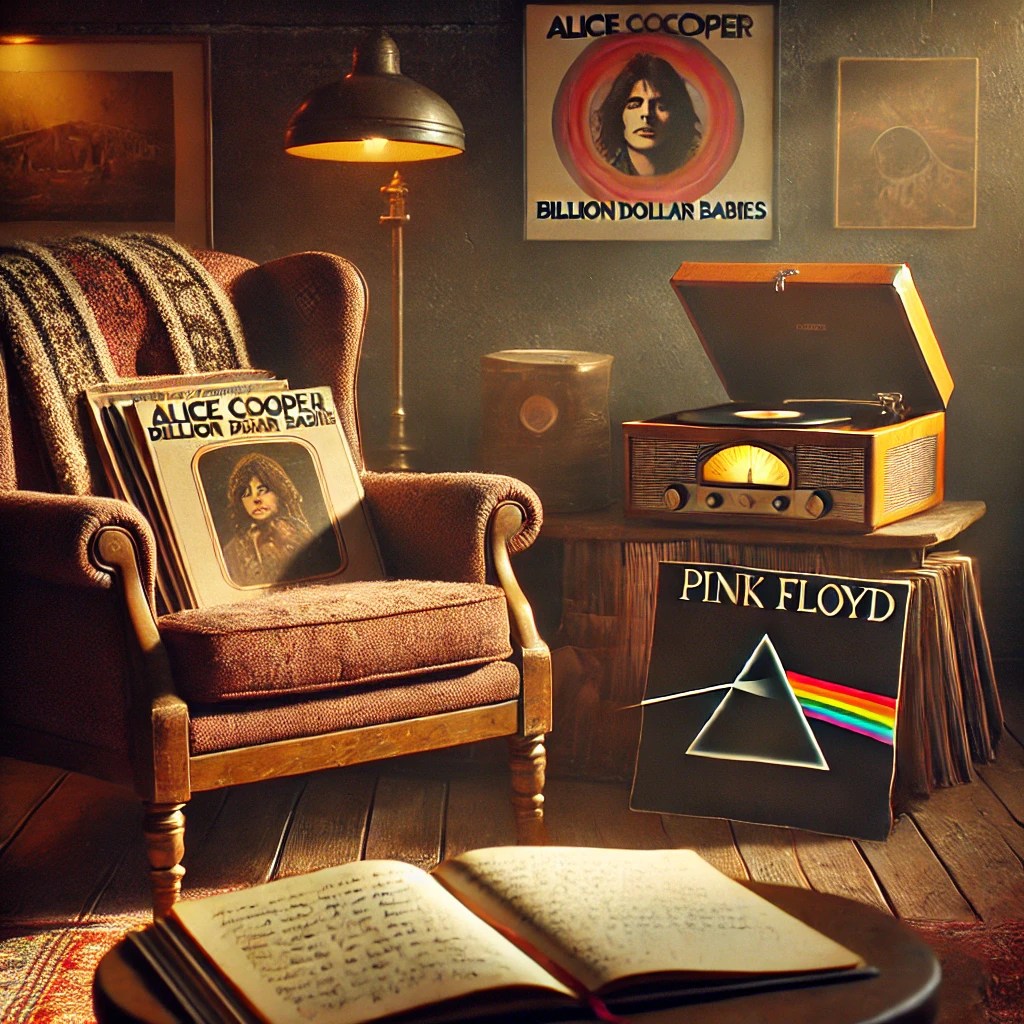
I’m a huge music fan, though I lack much musical talent. To expand my musical horizons, I’ve developed a listening habit that introduces me to new sounds regularly. I use tools like MusicRoamer and MusicMap to discover new artists and genres. I also work my way through Rolling Stone’s Top 500 Greatest Albums of All Time and explore stations on Radio Garden to uncover music from all over the world. Now that I’m retired, I spend even more time seeking out fresh sounds—but I often find myself revisiting the music and bands that defined my youth, like Alice Cooper.
Back in the 1970s, discovering new music wasn’t as easy. We had the radio and record stores, but not much else. Friends shared albums, though we were mostly in the same rock-focused bubble. Fortunately, I had my Uncle Dan. He was younger and cooler than my parents, and I looked up to him. Any chance I got, I’d visit him and explore his music collection.
In 1974, he handed me Alice Cooper’s bright green Billion Dollar Babies album. “Joey, I think you’ll like this,” he said. And he was right. To this day, I know every song by heart and can sing along to the entire album. It was unlike anything I’d ever heard.
I remember that moment vividly. I can recall him handing me the album, what he said, where I sat as I listened, and even reading the lyrics on the album sleeve. The opening track, Hello Hurray, left me wondering, “What is this?” Up until that point, I’d only heard Top 40 pop on KHJ and couldn’t really distinguish between The Monkees and The Beatles. I was just a kid, barely into my teens, with no real taste in music.
Uncle Dan—Danny, as I called him—introduced me to countless great albums and had a major influence on my early musical tastes. But it goes deeper than that. That first listening session is a rock-solid memory connected to music, time, and place. I have dozens of “first listen” memories stretching back to the ’60s. My first was Cheap Thrills by Big Brother & The Holding Company, back when I was about eight. Once again, it was with Uncle Dan, this time in his room at my grandparents’ house in Lynwood. I managed to get through to Turtle Blues before my grandfather stormed in, pulled me out of the room, and told me never to listen to that “garbage” again. At eight years old, I agreed—it seemed awful.
Around 1976, my little sister Lisa introduced me to Pink Floyd’s Animals. I was hooked. I listened to it in her bedroom on a tiny record player, but that was all it took. That album marked my true musical awakening. I can still recall every detail of that experience. She also introduced me to Supertramp. I have to admit, she was cooler than me in those days.
In 1978, I heard Steely Dan’s Aja for the first time in my friend Craig’s garage. The sound wasn’t great—a tiny record player on a plywood platform in the rafters of his garage—but the moment was magic. I knew of the band, but I hadn’t yet grasped their artistry. For weeks, I endured the hot, dusty garage until I could get my own copy.
There are dozens of albums tied to specific memories. Like driving to the beach with my friend Lester, listening to Boston, or playing D&D to The Wall. These musical moments have become cornerstones in my life, but they mean even more to me for a reason that may not be obvious.
When I was 18, I suffered a brain injury that left gaps in my memory and scrambled my recollections of my last two years of high school. I think of it as a “lost time stamp.” I may remember an event, but placing it in context is nearly impossible. I use writing to help piece together these memories; I jot down fragments and talk to others who were there. It works, to a point, but there are still moments when people ask, “Don’t you remember when…?”—and I don’t. Unless, of course, there’s music tied to the memory.




 Peanuts In My Pocket
Leave a comment