My mother passed away in 2023. Her death taught me a valuable lesson: I don’t need to collect things; especially the kind of stuff we often think of as junk. My sisters, their spouses, and a few close friends like Jan and her husband Don spent the better part of a year dealing with her… collections.
What I learned is to give away my junk and be highly selective about what I choose to keep. I’m still learning. Just this morning, I considered how nice it would be to collect bugs. Then I decided to collect bug photos instead. I consider that a win.
What we think is valuable often just becomes someone else’s problem. My mom had 200 cookbooks. We found a home for about 20, then donated the rest. She collected things that made sense, and things that didn’t. We tried our best to make sense of it all, but in the end, most of it ended up in a landfill. People really don’t want 125 moldy issues of Modern Woman. I’ve resolved not to repeat her mistakes.
That resolve breaks down when it comes to books. Once I buy one, it’s hard to let it go; especially if I read it and like it. I tell myself I might read it again, even though I rarely do. I’ve since learned to donate and rotate books through local little libraries. I’ve managed over a hundred donations so far. Still, I probably have a thousand or more books in storage (though honestly, I have no idea how many). These days, I try to limit myself. I now collect mainly poetry, photography books, and a few key reference texts.
My most recent purchase was The Days Run Away Like Wild Horses Over the Hills (1969), a collection of poems by Charles Bukowski. I picked it up at Bookmans in the City of Orange; an outstanding used bookstore. Someone there curates a really interesting Bukowski section. I’m guessing it’s one of the old guys behind the counter. I pick up something every time I visit.
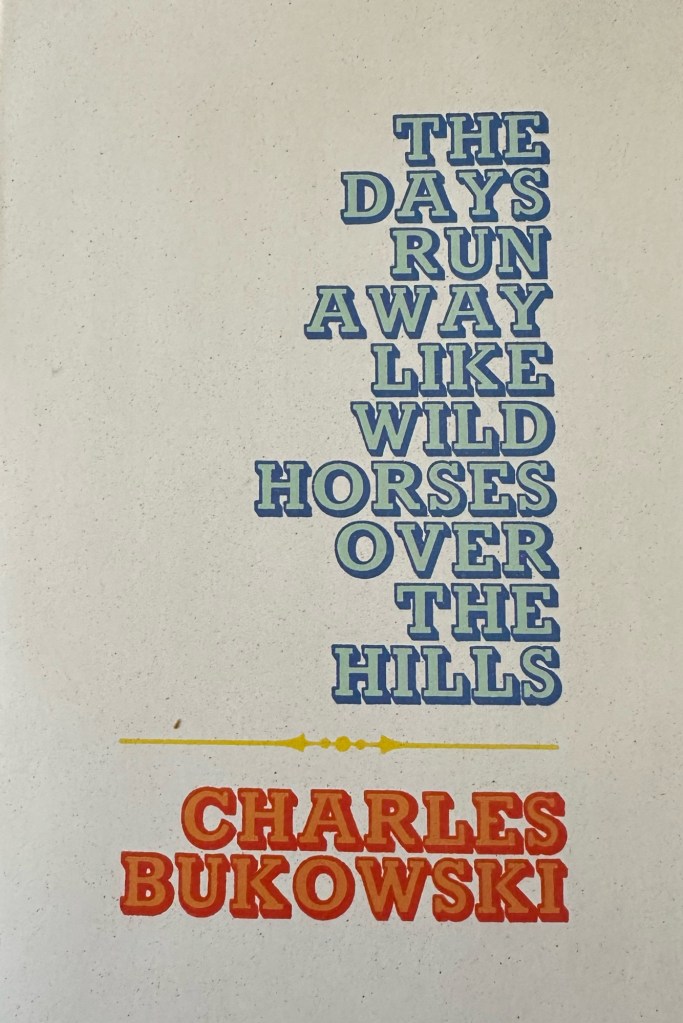
The collection contains 93 poems and is structured almost like a poetic journal or personal calendar. Bukowski wrote many of them day by day in the late 1960s.
The book is a mix of gritty, observational poems that reflect Bukowski’s classic themes: loneliness, poverty, drinking, sex, broken-down people, and the absurdity of everyday life. What sets this collection apart is its slightly more lyrical and introspective tone compared to his later, more brutal or sardonic work. You still get plenty of low-life debauchery, but it’s intercut with moments of startling vulnerability and unexpected beauty.
It also includes “The Crunch,” a brutally honest meditation on the dual nature of human beings and the world: beauty versus brutality, creation versus destruction. It’s been widely quoted and even used in ads and music. It’s a chilling first read. I cried. For context, I didn’t cry when my mom passed. The tears came later. In general, I just don’t cry much.
I find it hard to explain why I love Bukowski. On some level, I think I understand his prose better than that of many other poets. I’m still struggling through Clarity & Connection by Yung Pueblo. I consider myself a serious reader of poetry, and this collection feels overly simplistic and cliché. It reads like a series of unrefined self-help quotes. Yuck. I plan to donate this book, perhaps directly to the dumpster.


 Peanuts In My Pocket
Leave a comment