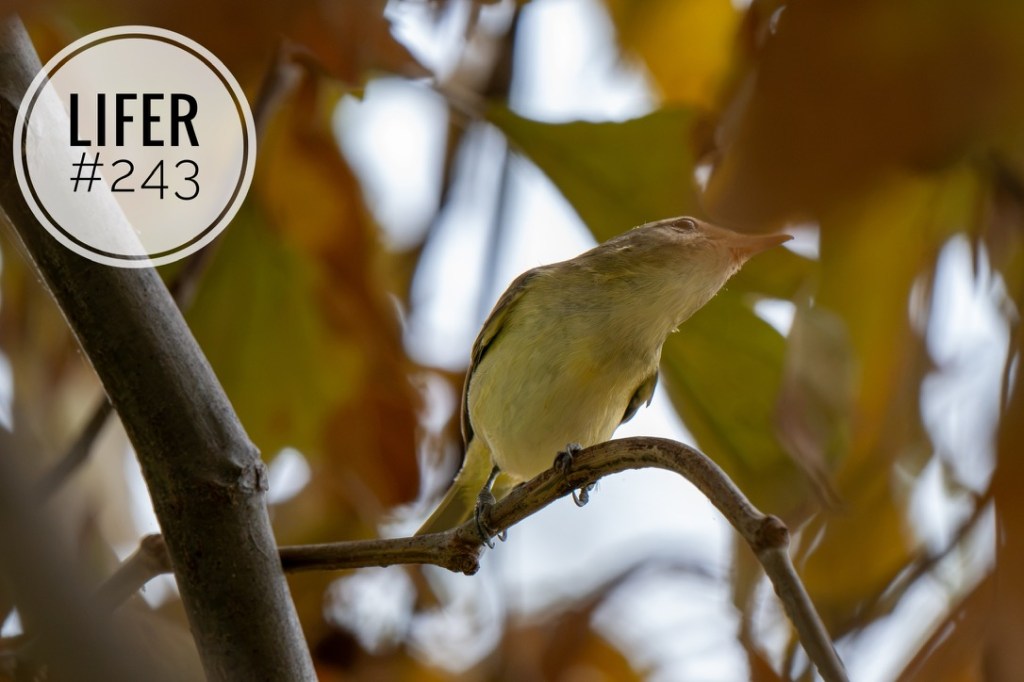
This is a Western Warbling Vireo, which, up until 2025, was simply called the Warbling Vireo. That year, it was split into two newly recognized species: the Western Warbling Vireo (Vireo swainsoni) and Eastern Warbling Vireo (Vireo gilvus). Although I was aware of the new species classification when it occurred, it didn’t matter much to me at the time because I had never seen a Warbling Vireo of any kind.
Now I have.
This is bird #243 on my life list.
It’s been slow going these past few months, despite traveling to find new birds. I’ve got a trip to Nevada planned soon, and then Florida and the Everglades in November. I’m hoping those trips will add another 20 or 30 birds to the list. Still, with my goal of reaching 300 birds this year, I’m starting to wonder if I might fall short.
I’ll keep grinding, with three or four birding outings a week whenever I can manage it.
Having my wife along as a spotter, and as a birder in her own right, really helps. I think of myself as a hearing- and vision-impaired birder. I can only hear out of one ear, and I’m color blind with poor vision, so my wife’s help in the field is essential. We make a good team.
She does get a little frustrated with me sometimes.
She’ll point out an obviously, at least to her, yellow bird sitting in a tree and give me increasingly specific directions while I stare helplessly into the branches. Sometimes she’ll finally take my camera, photograph where the bird is perched, hand the camera back to me, and let me use her photo as a map so I can find the bird and take a better picture.
This happened most recently with an Black Oystercatcher. No matter how well she described where it was, I simply could not see the damn thing.

More on the Western Warbling Vireo, via All About Birds and ChatGPT:
The Western Warbling Vireo (Vireo swainsoni) is a small, rather plain songbird about 4.7–5.1 inches (12–13 cm) long, with grayish-olive upperparts, whitish underparts often washed pale yellow along the flanks, a whitish eyebrow, dark eye line, and a relatively stout, slightly hooked bill. It breeds across much of western North America in deciduous and mixed woodlands, particularly riparian habitats dominated by cottonwoods, aspens, willows, and other trees near streams, ponds, and wetlands. It is a medium- to long-distance nocturnal migrant, moving south through the western United States and Mexico to wintering grounds farther south. Western Warbling Vireos are primarily insectivorous, methodically searching branches and foliage for caterpillars, beetles, true bugs, and other arthropods, while adding small fruits to their diet, particularly outside the breeding season.



Leave a comment